Helping communities build energy resilience and be ready for climate-related disasters
Project background
Energy Consumers Australia had been receiving frequent calls from communities wanting to become more energy resilient, but unsure where to start.
This inspired a partnership between Energy Consumers Australia, the Institute of Sustainable Futures (at University of Technology Sydney) and Community Power Agency, to develop a Toolkit to empower ‘energy ready communities’ in the context of disaster preparedness.
Community Power Agency was engaged to work with six diverse communities who had experienced (or were at risk of experiencing) natural disasters to inform the development of the approach and resources used in the Toolkit. Designer Chris Gaul from Parallel Lines designed the attractive and practical resources, which received a Good Design Australia Award in 2024.
The resulting Toolkit combines expert insights with firsthand community knowledge of disaster preparation and response, to provide comprehensive support for energy resilience.
We began by conducting research and stakeholder mapping, before working with community representatives to design and coordinate a series of community engagement workshops
Community Power Agency’s previous engagement coordinator, Dr Elianor Gerard, and Director Kristy Walters, travelled the east coast of Australia, from the Mornington Peninsula to Magnetic Island, consulting with the six communities of Bonang, Gympie, Mullumbimby, Mornington Peninsula, Lake Macquarie, and Magnetic Island.
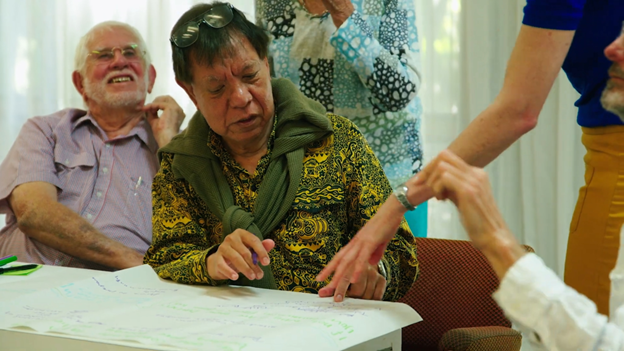
This series of community engagement workshops formed the basis of a co-design approach to create customisable resources for a range of different communities and their geographic and social contexts.
The basis of our approach was to make decisions with communities, not for them, and together, to build an energy future where communities are not just surviving, but thriving.
Project outcomes and impact
Key findings
Communities with lived experience of natural disasters and extended power outages have a wealth of knowledge and expertise to share on what to do (and what not to do) in crisis situations. They also know how to build local resilience by utilising their communities’ assets and local knowledge.
Being energy ready is everyone’s business. A resilient community is one with plans in place to enable a safe and dependable energy supply, even in a disaster. The importance of social connection, and the intersection between communication and energy, cannot be overstated in the context of disaster preparedness.
Common attributes of a resilient community are:
Understands risks and is well prepared
Knows its strengths and builds on them
Works together and looks after everybody
Values inclusion and participation
Can self-organise and build capacity
Able to adapt, learn, improvise and innovate
Good leadership and strong local networks
Good decision making and communication
Impact
The Energy Ready Toolkit equips communities to achieve a high degree of energy resilience, helping them prepare for increasingly extreme weather events and emergency situations.
The Toolkit can be used to support collaboration and help community members work together to make the best use of their local assets, knowledge, connections, and capacity, to achieve a higher state of energy resilience.
The Energy Ready Toolkit contains the Energy Ready Guidebook and materials for a series of activities that communities can undertake to examine the risks they face, identify shared priorities, and develop a plan of action that’s tailored to their unique needs and values.